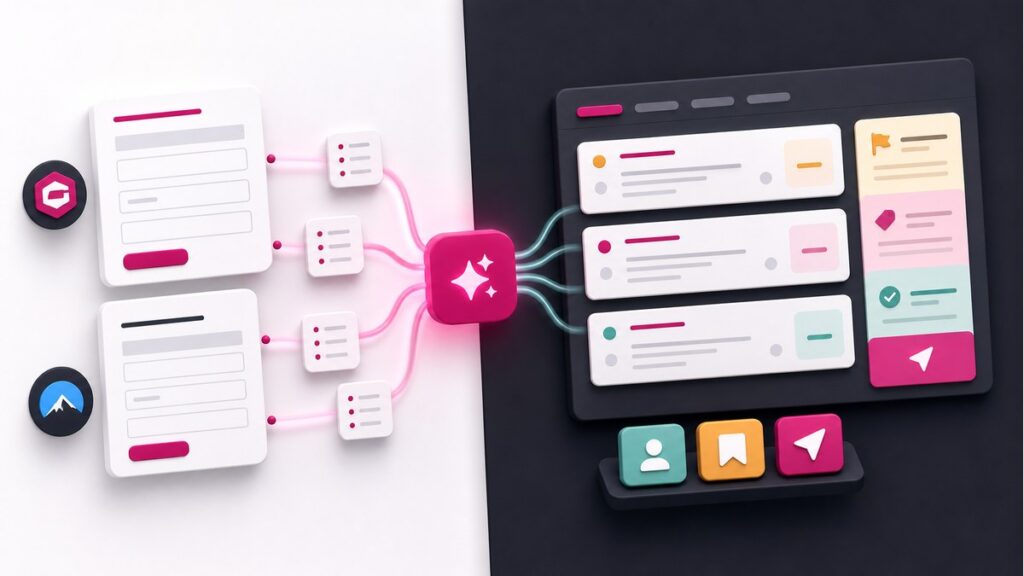
AI review is easy to sell as a feature and hard to defend as a line item unless a WebMaster can show what changed. The useful question is not “Did AI read the form?” The useful question is “Did the team spend less time finding the right next step?”
That makes ROI a workflow measurement, not a magic number. Start with one busy form, track what staff already does after each submission, and compare the before-and-after cost of review, routing, and follow-up.
Start with the work people already do
Most form review cost hides in small handoffs. A receptionist reads the same message twice. A sales rep asks for missing context. A site owner opens the entry, the email notification, and a CRM tab before assigning the request. None of those steps looks expensive by itself. Together, they slow down response time and make ownership fuzzy.
Before adding any AI action, write down the current review path for one form. Keep it plain:
- Who sees the submission first?
- What do they need to decide?
- Where do they record the decision?
- What usually causes delay or rework?
That baseline keeps the ROI discussion honest. If the staff process is already clear, AI review might not be the best first investment. If the same judgment call repeats every day, that is a better candidate.
Track three returns, not one vague promise
A practical ROI check separates time, quality, and control. If you blur those together, the result becomes a sales story instead of an operating signal.
| Return to measure | What to track | Why it matters |
|---|---|---|
| Review time | Minutes from submission to first useful action | Shows whether the team is moving faster, not just reading more data |
| Decision quality | How often staff changes the priority, owner, or next step after review | Shows whether AI output is helping or adding noise |
| Operational control | How often the result is visible where staff already works | Shows whether the workflow became easier to audit |
Sentient Forms is most useful when the result stays close to the submission. The Entry Summary action can shorten the first read. Lead Scoring can help sort high-fit inquiries from weak ones. Routing Recommendation can give staff a starting owner or queue.
Pick one pilot form with real review cost
The best first form is rarely the prettiest form. It is the one with enough volume, enough value, and enough repeat review work to make the change visible.
Good pilot forms usually have at least one of these traits:
- Quote requests where missing context delays an estimate.
- Contact forms where urgent messages get mixed with low-fit inquiries.
- Support intake where the first reply depends on tone, product area, or risk.
- Agency client sites where the WebMaster has to explain what happened after submission.
If you use Gravity Forms, compare the AI result against the entry workflow your staff already knows. Gravity Forms documents its entry management flow in its official entry management guide, which makes it a good place to define before-and-after review steps. For Contact Form 7 and WPForms, keep the measurement tied to after-submission review through the Sentient Forms Submission Ledger rather than assuming Gravity Forms-style entry notes or realtime behavior.
Use a before-and-after sheet
You do not need a complicated analytics stack for the first pass. A small before-and-after sheet is enough if the fields map to decisions the team already makes.
| Field | Before AI review | After AI review |
|---|---|---|
| First owner assigned | Who picked it manually? | Did the suggested owner help? |
| First response time | How long until a real reply? | Did the team reply sooner? |
| Missing context | How often did staff ask for more details? | Did the review flag gaps earlier? |
| Low-fit submissions | How often did staff spend time on poor-fit requests? | Did triage make that visible earlier? |
Keep the pilot short. Two weeks is often enough to learn whether the action is helping. If the staff ignores the output, the issue may be action design, form quality, or placement in the review flow. Treat that as evidence, not failure.
Keep support boundaries in the scorecard
ROI gets distorted when every builder is treated as if it has the same hooks and entry model. Sentient Forms currently supports Gravity Forms, Contact Form 7, and WPForms, but the support shape is not identical.
Gravity Forms has the fullest native path, including validation and realtime modes where available. Contact Form 7 and WPForms support after-submission actions through the Submission Ledger. Do not score those builders on Gravity Forms-only behavior such as realtime clarification, validation blocking, native spam status, notification suppression, webhook suppression, or native entry notes unless the installed version and public documentation prove that exact capability.
That boundary protects the WebMaster. It also keeps the ROI report from promising a workflow the site cannot run.
Review the result monthly
Once a pilot is stable, run a short monthly review. Look for two things: whether the form still deserves AI review, and whether a different action would now be more useful.
A form that began with Spam Detection may later need lead triage. A form that began with summaries may need Missing Information Review after staff sees which fields cause rework. The ROI improves when the action matches the bottleneck.
The best AI form review earns its place by making the next human step clearer.
If you want to test this on an existing WordPress form, start with the Sentient Forms action library and install the current plugin from WordPress.org. Keep the first pilot narrow enough that a WebMaster can explain the before-and-after result without a dashboard meeting.
Start with time from submission to first useful action. It is simple to observe and close to the work staff already does.
Measure whether staff uses the output and whether it improves the next step. Accuracy matters, but a technically correct summary that no one reads does not create workflow ROI.
Use the same business metrics, but adjust capability expectations by builder. Gravity Forms, Contact Form 7, and WPForms do not expose the same native workflow features.