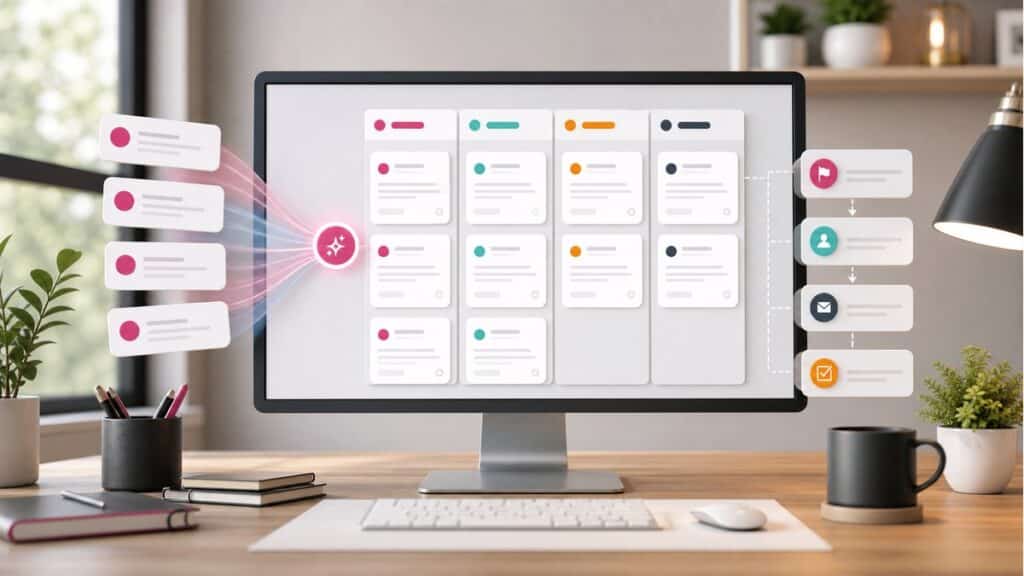
An AI provider can change its models, pricing, availability, or account terms. Your form operation should not have to start over when that happens.
Portable WordPress form automation keeps the durable parts of the workflow under your control: the form, the action’s purpose, the original submission, the review record, and the human handoff. The provider path is still important, but it should be a replaceable dependency rather than the place where the whole process lives.
Portability does not mean every model produces identical results or that migration is a one-click event. It means you know what must stay stable, what will change, and how to test the difference before real submissions depend on it.
Separate the workflow from the provider path
Start by writing the workflow in plain operational terms. For example: “Review every partnership inquiry, flag missing project details, and send uncertain cases to Jamie by 3 p.m.” That rule remains useful whether the model request runs through a site-owned provider account or a managed service.
If the workflow is described only as a provider name, model ID, and prompt, the team cannot easily tell what must survive a change. Keep the business outcome and ownership rule visible beside the technical settings. Sentient Forms separates the action you configure from the provider path that executes it, which makes that operating distinction easier to maintain.
Inventory what stays and what changes
| Workflow element | What to preserve | What may change |
|---|---|---|
| Form and field mapping | Required inputs, consent, and field meaning | Provider-specific formatting |
| Action instructions | Business goal, decision rule, and expected output | Model-specific phrasing or schema constraints |
| Credentials | Named owner and rotation process | API key, account, or managed-service route |
| Model selection | Required capability and acceptable behavior | Model ID, provider, latency, and availability |
| Submission record | Original entry and reviewable action result | Where a Form Source exposes native notes or links |
| Human handoff | Owner, deadline, and escalation rule | Notification channel or queue |
This inventory is also a useful agency handoff. It tells a new site owner which pieces are customer records, which are operating rules, and which depend on a vendor account.
Keep the source submission reviewable
A provider response is not a substitute for the original form submission. Preserve the source record first, then associate the action result with it. That gives staff something stable to inspect when a model changes, an output looks odd, or a provider is temporarily unavailable.
The exact review surface depends on the Form Source. Gravity Forms has the deepest native integration. Other supported sources can use the Sentient Forms Submission Ledger as the common review surface. The important operating rule is source-neutral: a reviewer should be able to connect the decision back to the submission that caused it. See the AI form review and audit-trail guide for a practical record structure.
Build a small test pack before switching
Create a redacted set of representative submissions before you change a provider or model. Include an obvious pass, an obvious exception, a borderline case, a sparse submission, and one example with the formatting that most often causes trouble. Remove personal information that is not needed for the test.
Run the same pack through the current and proposed setup. Compare the outputs against a written acceptance rule, not memory. The model-change retesting checklist shows how to keep that comparison narrow and repeatable.
Compare behavior, not just price
- Output fit: Does the result still match the format your next step expects?
- Exception rate: How often does a human need to correct or reinterpret the result?
- Response time: Does the action finish within the operational window?
- Failure behavior: Can staff find the original submission and understand what needs attention?
- Data path: Does the proposed route match your privacy and credential-management requirements?
Provider routing can also affect which models are available and how fallbacks are chosen. Review the provider’s current documentation before treating a routing rule as permanent. OpenRouter, for example, documents its provider-selection controls and the trade-offs they introduce.
Know what will not move automatically
Credentials, model identifiers, provider-specific options, usage records, and billing arrangements usually require deliberate review. A new model may also interpret an instruction differently even when the words are unchanged. Treat those items as migration work, not as hidden implementation details.
Retention deserves the same clarity. Decide which form submissions and action results WordPress should keep, who can see them, and when they should be removed. The WordPress form data retention guide provides a starting framework.
Use a seven-step provider-change plan
- Write the action’s business outcome and human owner.
- Inventory the form mapping, instructions, credentials, model, records, and handoff.
- Create a redacted test pack with clear expected outcomes.
- Configure the proposed provider path without removing the known-good setup.
- Compare output fit, exceptions, response time, failure behavior, and data path.
- Document the settings that changed and the person who approved the switch.
- Monitor the first real submissions and keep a rollback decision ready.
That is the practical return on portability: a provider change becomes a bounded operating task instead of an emergency rebuild.
The workflow is portable when its purpose, form mapping, source submissions, review records, and human ownership remain understandable outside one provider account. Provider-specific credentials, model IDs, and options can then be changed deliberately.
No. Models and providers can behave differently even with similar instructions. Use a fixed, redacted test pack and explicit acceptance rules to decide whether the new behavior is suitable.
Test representative submissions for output format, exception handling, response time, failure visibility, and the data path. Confirm the source submission remains reviewable and that a named person owns the first live checks.
Make the next change easier now
Choose one live form automation and write its outcome, owner, source-record location, and provider-dependent settings. If any of those are unclear, fix the operating record before the next vendor or model change forces the question.