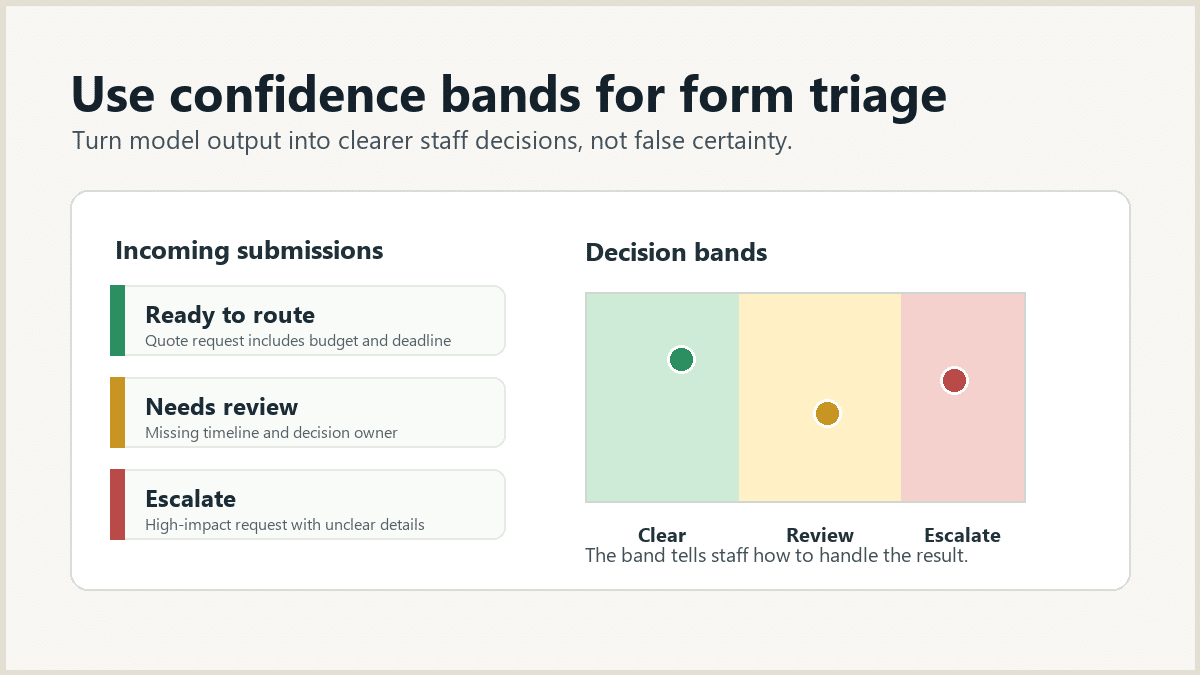
A form triage result is only useful when staff know how much to trust it. A single label like “good lead” or “urgent” can help, but it can also hide uncertainty.
Confidence bands turn the output into a working rule. Instead of asking a model to sound certain, the workflow tells staff whether the entry is ready to route, needs review, or should be escalated before anyone acts.
Use bands, not false precision
A percentage can look scientific even when the underlying judgment is still a language-model assessment. For many form queues, three bands are easier to use than a numeric score.
| Band | Staff meaning | Good next step |
|---|---|---|
| Clear | The entry has enough evidence for a routine next step. | Route it to the normal owner. |
| Review | The result may be right, but one or two facts need a person. | Read the evidence and choose the owner manually. |
| Escalate | The entry is sensitive, high-impact, or too incomplete. | Move it to a human decision lane. |
This framing is especially useful for lead scoring, routing suggestions, sentiment review, and missing-information checks. The point is not to make the model timid. The point is to make the handoff legible.
Tie the band to submitted evidence
A confidence band should never stand alone. Ask the action to show the facts it used. That might be budget language, a deadline, product fit, a missing phone number, or the words that made an entry look urgent.
For structured output, the model result should be small and predictable enough for staff to scan. OpenRouter’s documentation on structured outputs is a useful public reference for why predictable fields matter when an AI result needs to be parsed or checked.
- Decision: what should happen next.
- Band: clear, review, or escalate.
- Evidence: the submitted facts behind the recommendation.
- Missing context: what the action could not safely infer.
- Owner: who should look at it next.
Match each band to a workflow
The band only saves time if it changes the queue. A “review” label that still lands in the same inbox with no owner will not help. Write the workflow rule next to the band.
For example, a clear lead-scoring result can go to the normal sales owner. A review-band result can stay in the daily queue. An escalate result can go to a manager or subject-matter owner. Sentient Forms has action pages for Lead Scoring, Routing Recommendation, and Sentiment and Urgency if you want to map bands to a specific review job.
A confidence band should reduce debate. If it adds debate, the band names or the workflow rule are too vague.
Start with the review band
Most teams should design the middle band first. That is where AI review earns trust. The obvious entries were already easy. The confusing middle is where staff reread the same fields, ask the same follow-up questions, or delay ownership because the request is not clean.
Write the review-band rule in plain language. “Needs review because the budget is missing” is useful. “Medium confidence” is not enough. The first phrase tells staff what to check; the second phrase only names the uncertainty.
Keep builder-specific behavior out of the triage promise
Where the result appears depends on the current form source and action lifecycle. The safest public wording is to promise a WordPress-visible review result for supported form submissions, then verify the exact setup against the current action library and WordPress.org listing.
That matters because native write-back, pre-submit behavior, notification controls, and ledger-backed after-submission review are not interchangeable. A useful triage article should help the WebMaster set the right operating rule without implying every form builder exposes the same controls.
A first-pass confidence rubric
- Clear: the entry names the need, has enough contact detail, and matches the form purpose.
- Review: the entry is probably useful but has missing details, mixed intent, or an unclear owner.
- Escalate: the entry includes sensitive content, a high-value request, a complaint, or a risk the model should not decide alone.
- Reject or spam: only use this when the action and form setup are explicitly designed for that workflow.
If this is part of a broader operating cleanup, pair it with the guide to give every WordPress form submission a clear owner. If the team is still picking the first workflow, start with finding revenue leaks in the form queue.
What to report after one week
Do not report model accuracy as if it were a lab result. Report the operational change: how many entries were clear enough to route, how many needed review, how many escalated, and what staff changed after reading the evidence.
That gives a WebMaster a practical improvement loop. The goal is not perfect certainty. The goal is a queue where the next human step is easier to see.
Frequently asked questions
No. A confidence band is an operating rule for staff. It should not be presented as a measured accuracy claim unless you have a separate validation study.
Start with three: clear, review, and escalate. More bands usually create extra debate before the team has proof they help.
They can guide the review workflow, but exact result placement and controls depend on the current form source, action, and Sentient Forms release.