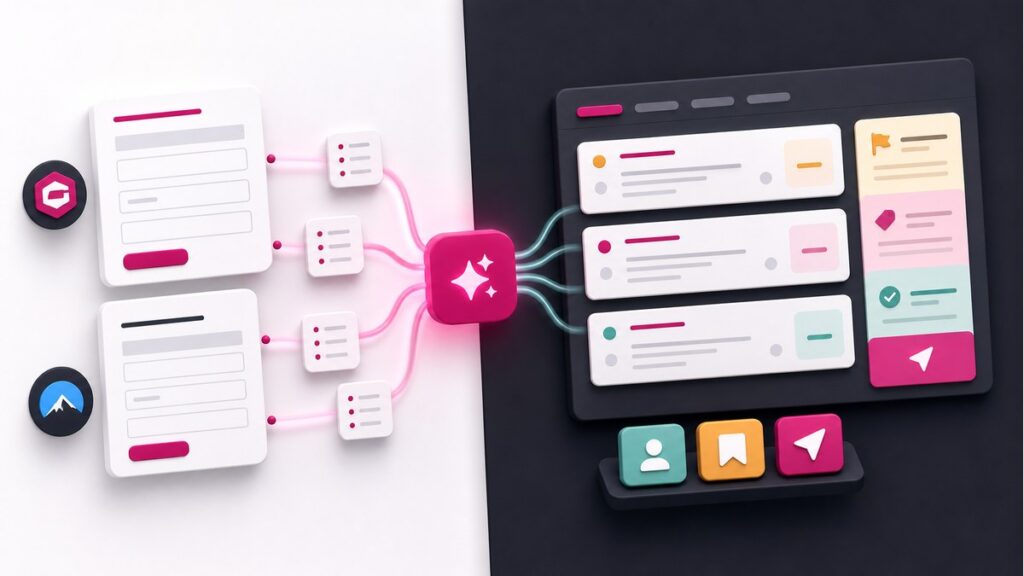
Pre-launch tests answer one question: did the workflow handle the examples you expected? They do not tell you how it behaves after visitors bring new wording, missing context, seasonal requests, and edge cases you did not anticipate.
A human review sampling plan keeps AI form actions useful without asking staff to reread every result forever. The plan should choose the right submissions, ask the same short questions each time, and turn findings into bounded changes.
Define what a bad result would cost
Start with the action’s role in the workflow. A draft summary that a staff member reads before replying has a different risk than a score used to reorder a busy sales queue. Write down what the output influences, who sees it, and how a person can override it.
Increase review attention when an output can delay a response, hide a legitimate inquiry, expose sensitive text to more staff, or change a customer-facing message. Keep high-risk or regulated decisions out of a general form automation unless the full legal, technical, and human-review process is appropriate for that use.
Sample by lane, not by convenience
Reviewing the easiest recent entries creates false comfort. Build a small sample from the lanes that reveal different failure modes.
- Routine submissions show whether normal performance remains steady.
- Low-confidence, ambiguous, or incomplete submissions test uncertainty handling.
- Rare services, locations, languages, or answer combinations expose coverage gaps.
- Staff overrides reveal where the result and the operating judgment diverged.
- Errors, retries, and delayed runs test the fallback path rather than only output quality.
If the action assigns confidence, use the confidence-band guide to keep uncertain cases visible. Do not treat a confident tone as proof that the result is correct.
Use one short review card
A long audit form will be skipped. Ask reviewers the same five questions so results can be compared across weeks and staff members.
- Did the action use the right submitted facts?
- Is the result accurate enough for its stated purpose?
- Does the explanation make the recommendation easy to inspect?
- Did the workflow keep uncertainty, missing information, and errors visible?
- What should happen next: keep, clarify, adjust, pause, or escalate?
Score the output against the action’s job, not against an imaginary perfect answer. The verifiable prompt guide helps turn vague expectations into checks a reviewer can actually apply.
Record overrides without assuming the human is always right
An override is evidence, not automatic ground truth. Ask for a short reason: missing context, wrong policy, ambiguous form answer, outdated example, reviewer preference, or model error. A repeated reason is more useful than a pile of unexplained thumbs-down votes.
Count the reason for an override, not just the override.
Preserve the submission reference, action, result, reviewer decision, and date. The audit-trail guide shows how to keep that evidence reviewable without copying full form payloads into another tool.
Review after changes and on a steady cadence
Run an extra sample after a form field, action prompt, example set, model, provider path, plugin version, or business rule changes. Between changes, choose a cadence the owner can sustain and record when the next review is due.
This is ordinary post-deployment monitoring, not a claim of formal compliance. The NIST AI Risk Management Framework Core calls for testing before deployment and monitoring while systems are in operation. Its guidance also stresses documented test sets, human oversight, change management, and mechanisms for appeal or override.
Inspect the surface staff actually rely on
Review the result where the Form Source promises to show it. Gravity Forms has the deepest native Sentient Forms integration. Contact Form 7, WPForms, and Elementor Pro Forms use limited after-submission paths through the opt-in Sentient Forms Submission Ledger. Native notes, spam status, validation, notifications, and webhooks are not universal review surfaces.
Also inspect the operational fallback. If a run fails or a reviewer disagrees, does the original submission remain visible and owned? The human-review fallback guide explains why a visible queue is often safer than forcing every uncertain result into an automated decision.
Turn findings into one bounded change
Group findings by cause before editing anything. A form question problem calls for a form change. A missing business rule calls for better context or instructions. An inconsistent result may need examples or a narrower action. A workflow error needs an operational fix, not a more persuasive prompt.
Change one cause at a time, rerun the failed examples, and keep a stop condition. The stop-button guide gives teams a clear way to pause an action without losing the underlying form workflow.
Install Sentient Forms from WordPress.org and start with one low-risk action. Save a small review sample, name its owner, and put the next review date on the same change record.
Frequently asked questions
There is no universal number. Choose enough submissions to cover routine, uncertain, rare, overridden, and failed lanes, then increase attention when the output can create greater harm or operational cost. Record the method so the next review is comparable.
No. Low-confidence results deserve attention, but a sample should also include routine high-confidence outputs, rare conditions, staff overrides, and workflow errors. Otherwise a confident but repeated mistake can remain invisible.
Use the surface promised by the installed Form Source. Gravity Forms has the deepest native integration. Contact Form 7, WPForms, and Elementor Pro Forms use limited after-submission review through the opt-in Sentient Forms Submission Ledger.